When homeowners search for how to put granite on countertop they quickly discover that professional granite countertop install methods differ sharply from any DIY approach. This guide compares the steps fabricators follow with the realities of attempting the work yourself so you can decide what fits your project in the Dallas area.
Table of contents
- Professional granite countertop install process
- DIY considerations and common pitfalls
- Key decision factors for homeowners
- Preparation steps before any install
- Material choices and local options
- Aftercare and long-term maintenance
- Common mistakes to avoid
- Local considerations for the Dallas metroplex
- FAQ
Professional granite countertop install process
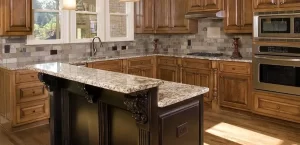
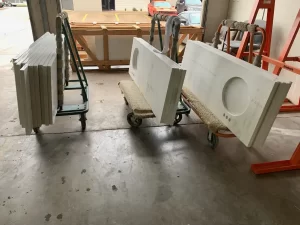
A professional team begins with an in-home template visit after cabinets are installed and level. They measure every angle with digital tools so the granite fits exactly once cut at the shop. Slabs are selected from inventory or ordered, then cut on CNC equipment that produces clean edges and precise sink cutouts. On install day the crew carries the finished pieces inside using suction cups and leveling tools to set each section on a bed of silicone or epoxy. Seams are filled and polished on site so the surface looks continuous. Because the fabricator handles transport and heavy lifting there is far less risk of cracking the stone during movement.
Local homeowners in areas such as Dallas, TX or Plano, TX benefit from same-day or next-day scheduling when cabinets are ready. The crew also checks plumbing and electrical clearances before leaving so the sink and faucet can be connected without delay.
DIY considerations and common pitfalls
Attempting to put granite on countertop yourself requires renting or buying heavy-duty equipment including a wet saw capable of cutting thick stone, diamond polishing pads, and a template material that stays stable. Even small measurement errors can leave gaps at walls or around sinks that are difficult to hide. Moving full-size slabs demands at least two strong helpers and proper lifting straps; one slip can chip an edge or crack the entire piece. Sealing must be done correctly on all sides before placement or moisture can enter from below. Most DIY attempts end up costing more once damaged stone is replaced and professional help is called in to finish the job.
Key decision factors for homeowners
Budget, timeline, and access to the kitchen all influence whether a professional granite countertop install makes sense. If your cabinets sit on an uneven floor or the sink model has an unusual shape, templating on site prevents costly rework. Homeowners who value a warranty on both material and labor usually choose professional service. Those who already have experience with stone or have a small remnant project may explore limited DIY options, but the weight and precision requirements remain high. Checking your service area first helps confirm whether a fabricator can reach your neighborhood on the needed date.
Preparation steps before any install
Clear the kitchen of appliances and remove the old countertop. Confirm that base cabinets are securely fastened and perfectly level; shims can be added but major adjustments should happen before templating. Mark the exact location of the sink, cooktop, and any outlets. Have the new faucet and disposal on hand so measurements can be verified. If you plan to reuse existing plumbing, photograph the current setup for reference. These steps keep the professional crew focused on placement rather than waiting for other trades.
Material choices and local options
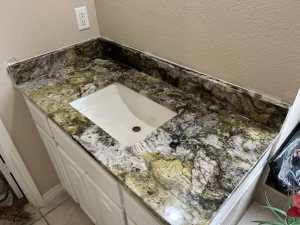
Granite remains popular because of its natural patterns and heat resistance, yet many homeowners also review quartzite or other stones during selection. Visiting a showroom lets you compare thickness, color consistency, and edge options under the same lighting that will appear in your kitchen. Local inventory changes often, so checking current Materials pages or calling ahead saves time. Remnant pieces can work well for smaller islands or vanity tops when the color matches your main slab.
Residents in Frisco, TX and Lewisville, TX frequently combine a primary granite slab with a matching remnant for a backsplash or window sill, creating a coordinated look without ordering extra material.
Aftercare and long-term maintenance
Once the granite is installed, avoid heavy impact near seams and wipe spills promptly. Reapply a penetrating sealer according to the fabricator’s schedule, usually once a year in high-use kitchens. Use cutting boards and trivets to protect the surface. Professional installers often provide a care kit and written instructions tailored to the specific stone chosen.
Common mistakes to avoid
One frequent error is rushing the cabinet leveling step before the template visit. Even a quarter-inch difference across the run of base cabinets can force the fabricator to make field adjustments that weaken seams or create visible gaps along the wall. Another common issue arises when homeowners select a sink model after templating; the cutout dimensions then require last-minute changes that delay the schedule and sometimes force a new slab order. Skipping the final site check for electrical and plumbing clearances also leads to callbacks once the countertop is in place. Finally, attempting to move slabs without proper suction cups or team lifting often results in edge chips that cannot be fully repaired on site. Reviewing the full Service Area list before booking helps ensure your neighborhood is covered on the day cabinets are confirmed level.
Local considerations for the Dallas metroplex
Homeowners across Denton, TX, Flower Mound, TX, and Highland Village, TX often face older homes with slightly out-of-square walls. Professional templating captures these variations so the granite can be cut with precise scribe lines rather than relying on caulk to hide gaps. In newer developments around The Colony, TX and Carrollton, open-concept kitchens with large islands require extra attention to seam placement so the pattern flows naturally across multiple slabs. Traffic patterns on major roads can affect delivery timing, which is why fabricators serving Irving, TX and Coppell, TX build buffer time into the install calendar. Checking current availability on the Service Area page or contacting the shop directly confirms whether your address falls within the same-day route. Many families in Addison, TX and Farmers Branch, TX also combine a main countertop project with a small remnant piece for a matching bathroom vanity, keeping the entire job on one schedule.
FAQ
How long does a professional granite countertop install take?
Most kitchens are completed in one day once the stone has been templated and fabricated. Complex layouts with multiple sinks or mitered edges may require an extra half day for finishing seams.
Can I install granite on existing cabinets without new templating?
No. Cabinets shift slightly during construction and walls are rarely perfectly straight. A fresh template ensures the granite fits without large gaps or overhang issues.
What tools are needed for a safe DIY attempt?
A wet saw with diamond blade, straight-edge clamps, suction cups rated for stone weight, leveling shims, and food-safe epoxy for seams are minimum requirements. Even with these tools, moving full slabs remains hazardous without professional equipment.
Does granite require special underlayment?
A plywood or MDF substrate is usually installed first to provide a flat, stable surface. The fabricator verifies this layer during templating so the granite sits evenly.
Is sealing required immediately after install?
Most granite arrives pre-sealed, but a final coat is applied on site after any seam work. Your installer will advise on the exact product and timing for your stone.
Ready to move forward with a professional granite countertop install? Contact AA Granite Fabrication Center today at (214) 441-7776 or visit our Request A Quote page to schedule a template appointment in your neighborhood.